Recycling and Sustainability at Kennington Movers
 At Kennington Movers, sustainability is not treated as an afterthought; it is built into the way our Kennington removals services are planned and delivered. Moving home or business premises can generate a surprising amount of waste, from cardboard and wrapping paper to broken fixtures, old furniture and redundant office items. Our approach to recycling and sustainability is designed to keep as much as possible in productive use, reduce unnecessary landfill, and support a cleaner local environment across Kennington and nearby boroughs. We aim to recycle at least 85% of the material collected through suitable moving and clearance jobs, with a focus on re-use first, then recycling, and only then responsible disposal.
That target is ambitious, but it reflects how a modern Kennington moving company should operate. We work with a clear hierarchy: identify items that can be reused, separate recyclable streams carefully, and ensure that residual waste is sent to the appropriate local facilities. In practice, this means sorting cardboard, soft plastics, metals, wood, and electricals wherever possible, rather than mixing everything together. It also means looking closely at borough-level waste expectations, because much of South London operates with structured approaches to separation, where dry mixed recycling, food waste, and residual waste are handled differently.
 Every move has its own sustainability profile, and our teams are trained to make quick, practical decisions that improve outcomes. For example, strong cardboard boxes are often kept for future use, packing paper is separated from plastic wraps, and bulky furniture is assessed for repair, refurbishment, or donation. In some cases, we will direct recyclable materials to local transfer stations that can process them efficiently, helping to reduce transport miles and supporting the circular economy in the area. This is a key part of our recycling-focused removals service, because it ensures the journey from property clearance to final processing remains as short and efficient as possible.
Another important part of our sustainability plan is our use of low-carbon vans. Our fleet is selected to help reduce emissions while still delivering the reliability required for domestic and commercial moves. Smaller loads may be carried using more efficient vehicles, while larger removals are scheduled to minimise repeated trips. Route planning also plays a major role: by grouping jobs sensibly across Kennington, Lambeth, Southwark, and neighbouring districts, we cut down on unnecessary mileage and fuel consumption. These measures support a lower-carbon version of Kennington movers logistics without compromising service quality.
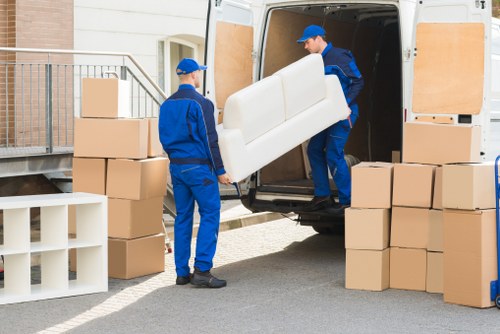 We also recognise that sustainability is about more than recycling bins and vehicle choices. It includes keeping useful items in circulation for longer, especially when they still have a valuable life ahead of them. That is why our Kennington removals team works with local charities and community organisations to donate suitable furniture, household goods, books, and office equipment. When a sofa, desk, shelving unit, or appliance is in good condition, it may be passed on rather than discarded. Partnerships with charities help reduce waste, support households in need, and give moved-on items a second life. This is especially relevant in a busy London area where high turnover can create a constant flow of reusable goods.
Our commitment to responsible handling also extends to specialist recycling streams. Items such as electrical equipment, batteries, light fittings, and certain metal fixtures require separate treatment, and we make sure these are directed to the right channels. In boroughs across the local area, waste separation is increasingly important, and we adapt our approach accordingly by keeping recyclable loads distinct and avoiding contamination. This is particularly useful where local guidance places emphasis on sorting paper, plastics, metals, and food waste separately. By aligning our operations with those expectations, Kennington movers can help clients reduce the environmental impact of a move while staying compliant with local waste practices.
 Local transfer stations are another essential element of our system. These facilities act as a practical bridge between collection and final recycling, allowing waste streams to be weighed, sorted, and dispatched to specialist processors. For move-related waste, this can be far more efficient than sending everything to general disposal. It also supports cleaner operations on the day, because our crews can quickly separate materials and ensure they are delivered to the correct destination. Where appropriate, we prioritise nearby routes to reduce travel time and emissions, keeping the overall Kennington moving service more sustainable.
We also work to reduce packaging waste before it is created. Whenever possible, we encourage the reuse of blankets, crates, and protective materials, and we favour durable packing solutions over single-use items. Our teams are careful to avoid over-packing, which cuts waste and lowers the volume of materials needing recycling later. In addition, we keep an eye on evolving borough policies around waste separation, because these can influence how items are processed after collection. Whether the material is corrugated cardboard, mixed plastics, or timber from dismantled furniture, the aim is always to channel it into the most suitable recovery route.
 Sustainability at Kennington Movers is not a single action but a connected process that runs through the entire removal journey. From low-carbon vans and efficient routing to charity partnerships, local transfer station use, and a strong recycling percentage target, every part of the service is designed to reduce waste and environmental impact. For customers seeking a recycling-aware Kennington movers team, the result is a move that is practical, responsible, and better aligned with the wider goals of a greener London. By treating reuse and recycling as standard practice, we help make each relocation a little cleaner, a little smarter, and a lot more sustainable.